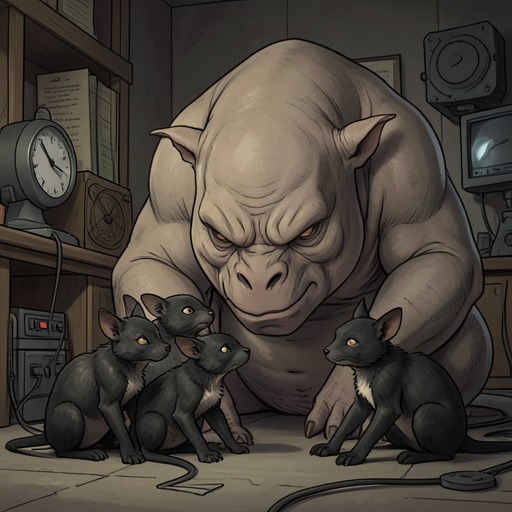
Dangerous Beans rejects Spider’s alliance
The Amazing Maurice and His Educated RodentsDangerous Beans rejects Spider’s alliance at the moment when its promise of strength seems most tempting. Spider offers a shared mind and power over the rat world; Dangerous Beans tests that promise against its cost to the weak and refuses. The confrontation makes a decisive distinction between thinking for many rats and thinking of them, and turns the Clan’s belief in cooperation into a choice made under pressure.
The offer and its source
Spider emerges as an assemblage of eight blind rats whose tails are knotted together. The rats move as though one creature controls their many legs, and Spider speaks directly into Maurice’s mind. He explains that humans tied rats together for sport and claims that, rather than struggle against the knot, the rats became strong together. His origin gives his political proposal a disturbing shape: unity, in his account, is the product of forced conjunction and a mind that has gathered the others under its control.
Spider imagines this collective power expanding beyond the eight rats. He expects the cages to open and promises a future in which rats will make humans understand the meaning of a plague. He tells Dangerous Beans that they share a mind capable of thinking for many rats and invites him to join in a common triumph. The offer borrows the language of cooperation, but its promised outcome is rule, warfare, and the survival of the strongest. Spider presents mass death as no objection because, in his view, rats die already.
The proposal answers real fear. Earlier, when rats ran past in panic, some had lost the ability to speak; Dangerous Beans recognized that something had frightened them badly. The Clan’s fire, by contrast, had been used to declare an identity beyond mere rat existence: its members could stand apart as a community. Spider offers protection from weakness by concentrating thought and power in a single controlling will. Dangerous Beans has to decide whether that apparent strength can preserve the very lives and independence it claims to defend.
Dangerous Beans tests the alliance
Dangerous Beans does not reject the offer with an immediate, simple denial. He acknowledges that the world is dangerous, that rats are weak, and that he is tired. He allows that joining Spider could make them strong and asks what would happen to those who were not strong. Spider’s answer is that the weak are food, as they have always been. The exchange makes the price of the offer explicit: Spider’s unity does not extend care or protection to every rat; it sorts the weak into victims.
Dangerous Beans then asks Spider to consider one of the large rats hypnotized by the flame and whether she has a thought of her own about the proposed future. Spider is taken aback by the question, treating the rat’s capacity to think as irrelevant. This moment exposes the central flaw in his claim to represent a collective. He can make many rats serve one purpose, but he does not regard them as individual minds whose wishes matter. Dangerous Beans concludes that the plan cannot work, not because coordinated strength is impossible, but because Spider’s supposed cooperation is founded on the denial of those he would command.
His refusal also answers Spider’s claim to embody the Big Rat. Dangerous Beans says that Spider thinks for many rats without thinking of them, and that his words about cooperation conceal lies. If the Big Rat exists, Dangerous Beans hopes, it would represent what rats can be at their best, not war and death as expressions of their worst. He admits the Clan can be silly and weak, but insists that together they are strong in a different sense. Spider has plans for rats; Dangerous Beans has dreams for them. The contrast turns an abstract dispute about power into a disagreement over what collective life is for.
From refusal to collective action
The confrontation gives practical meaning to an earlier declaration by Dangerous Beans: the flame marks the Clan as separate, not merely a collection of rats. That identity matters because the novel repeatedly distinguishes an individual rat capable of thought from a frightened mass. Maurice explains that many rats overwhelmed by shared fear can become a mob, a single animal with many legs and no brain. Spider’s group is an extreme, deliberate version of that fusion: its combined force comes at the expense of the separate minds Dangerous Beans insists should count.
The Clan’s arrival provides a sharp counter-image. Its rats advance together in a line; when attacked, they close around an enemy and then reform. When the opposing rats flee, the line breaks into pairs that pursue them. The conflict ends quickly. This disciplined action is not the same as Spider’s domination: the Clan’s members coordinate without being reduced to one mind, and their collective strength depends on each rat’s participation. The battle thus follows the ideological contest with a visible contrast between controlled cooperation and power imposed through a shared consciousness.
The distinction also resonates with Darktan’s earlier effort to rally a frightened squad. Faced with an unknown danger in the dark, he presents the rats’ ability to think, resist fear, and remain together as the qualities that make them strong. Dangerous Beans’s refusal gives that principle its moral limit: courage and coordination are not enough if the group’s weakest members are treated as expendable. The Clan’s strength must include regard for its members, rather than merely making them instruments of a larger will.
Consequences and significance
Dangerous Beans’s choice rejects both Spider’s proposed war and the assumption that survival must reproduce the old rule of the strong consuming the weak. It does not deny vulnerability: his acknowledgment of exhaustion and danger makes the alternative harder-won, not effortless. What he refuses is the claim that vulnerability justifies domination. A collective becomes more than an efficient weapon only when its members matter as minds and lives in their own right.
The story’s later human-rat negotiations extend this alternative from the Clan’s internal principle to relations between species. Keith urges the Mayor to speak with the rats rather than rely on dogs, brooms, and temporary expulsion; Darktan offers an opportunity to negotiate, and a committee works through the practical terms of a contract. The Mayor eventually asks why the rats did not poison wells or set houses on fire, and Darktan answers that killing humans would not improve the rats’ future or spare them from having to deal with people eventually. These later events do not make Spider’s offer the cause of the agreement, but they show the larger narrative direction opposed to his vision: durable strength requires a workable relationship, not victory achieved through the mass suffering of others.
The refusal therefore defines Dangerous Beans’s leadership as moral as well as intellectual. He recognizes the appeal of Spider’s power, questions who would bear its cost, and refuses to confuse a single will acting through many bodies with genuine solidarity. The decisive question is not whether rats can become strong together, but whether that togetherness protects their capacity to think, choose, and live. Spider offers a plan for rule; Dangerous Beans holds to a future in which the Clan’s shared strength remains answerable to the rats who compose it.